
Best Skincare Marketing Agencies in 2026
There’s a before and after on your phone that would sell out the product by Friday. Your reviewer won’t let you post it, and that one decision is going to shape every piece of creative you make this year.
The best skincare marketing agency depends on which part of the business is stuck. We at Hart & Highland fit when the gap is campaigns, creative, social, and influencer made by one team, and the other five here each own a different job, from packaging and search to press, the sales floor, and seeding.
Skincare runs on claims you have to be careful with and on customers who need a reason to buy a second bottle. An agency that’s fluent in the first and has an answer for the second is rarer than the client walls suggest.
So the useful sort is by the job that’s actually stuck at your brand, and that’s how the six agencies here are mapped.
Quick Answer: Hart & Highland fits skincare brands that need campaigns, creative, social, and influencer from one team. MSLK fits packaging and product development, Velox fits search and paid media, Tractenberg & Co. fits press and affiliate TV, Beauty Barrage fits in-store sales, and Kynship fits creator seeding with paid media behind it.
Key Takeaways
Hart & Highland is the best fit if the gap is campaigns, creative, social, and influencer in one team. We make four campaigns a year and the content between them in-house, with usage agreed before anything is shot.
Skincare agencies split into six jobs. Brand and pack, campaigns and content, search and media, press, in-store sales and seeding. Hire for the job that's stuck rather than the agency with the longest client wall.
The claims rule shapes every asset. Appearance language is cosmetic, and structure or function language is a drug claim, so a skincare brief has to start from what you're allowed to say.
The second bottle is where skincare brands make money. Ask any agency what it does after the first order, because launch energy fades and repeat rate is what pays for the next campaign.
Ask what each agency makes in-house. Owned gear, in-house post-production, and a team lead who stays on the account are the difference between a partner and a handoff.
How We Chose These Skincare Brand Marketing Agencies
We publish this list and put ourselves first, so the other five had to earn their place on three tests.
Fluency in skincare claims. Whether the team knows the line between a cosmetic claim and a drug claim before the shoot, since that line decides which shots and which words are usable.
What the brand gets after the first order. Skincare lives on reorders, so an agency with no answer for the second bottle is only doing half the job.
What's made in-house and what's passed on. The senior person in the pitch is often not the person who edits your video. Owned gear, in-house post, and a named team lead count for a lot here.
What Does a Skincare Brand Actually Need From an Agency?
A skincare marketing agency makes and places the marketing for serums, cleansers, sunscreens, body care, and everything in between. The field splits into six jobs, and almost nobody does all six well.
Two terms worth defining up front. A creative growth team is one team handling strategy, creative, and campaign management together rather than three companies each doing a piece.
A content engine is everything that keeps a skincare brand posting between campaigns, which means photo, video, UGC style content made to feel like a customer's own post, and design coming out of one plan.
The Best Skincare Marketing Agencies in 2026
1. Hart & Highland
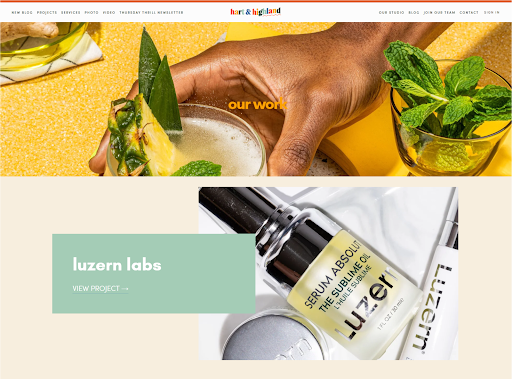
Hart & Highland was founded in 2018 by Arica Rosenthal and Kristen Schellenberg, and the reason it exists is a familiar marketing problem.
Arica's background is in-house marketing, where strategy, management, and execution each came from a different supplier.
The story broke every time the work changed hands, so they built one team where all three live together, and the through line never breaks.
Eight years on, we're a creative growth team in Santa Monica for consumer brands looking to scale their creative and their social, with Luzern Labs among the skincare names on our wall.
Our in-house strategists build each campaign around one story and carry it through creative production and social, with paid influencer amplification to push it further.
The model is four campaigns a year, one a quarter. Each comes with the concept, the shoot, the assets, the launch calendar, and the plan underneath, and the same team runs the content engine in between so the feed never goes quiet.
For skincare, the shoot is where the difference shows.
We own our gear and run post-production in-house, which means the texture shot, the swatch on skin, and the before shelf and after shelf of a routine get planned around what the claim allows rather than fixed in the edit.
Creator work runs on micro and nano tiers by default because a real routine from a smaller account reads as proof, whereas a celebrity feed reads as an ad. Email and SMS are live services for the brands that need the second bottle to follow the first.
There's no account manager layer. You work directly with the social lead, the producer, and the creative manager on your brand, and usage is agreed in writing before anything is shot.
Best for: funded skincare brands with a small in-house team, often one social manager, who need campaigns, creative, social, and influencer made by one team rather than another supplier to manage.
Where we fall short: we don't buy media, run PR, or give legal advice. We make the work, including the assets built for ads, then work alongside whoever buys your media, runs your PR, and signs off on your wording.
2. MSLK
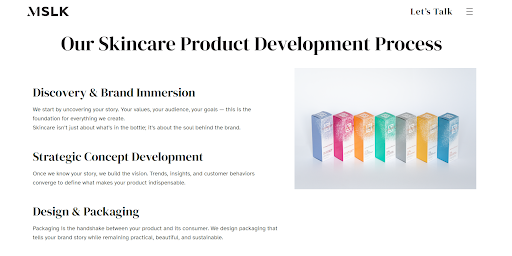
MSLK is a brand and packaging agency in Queens, New York, with more than 25 years in skincare product development by its own count. The work covers positioning, packaging design, go-to-market planning, and regulatory compliance, and the agency says it has worked with more than 100 brands.
Epionce, Skin Type Solutions, Lavanila and Joico are among the names it lists. Its playbook sits before launch, so a brand coming to MSLK usually leaves with a product and a pack rather than a running social calendar.
Best for: a new skincare line, a rebrand, or a product that needs the bottle and the positioning sorted before anyone shoots it.
Where it beats us: packaging and product development, which Hart & Highland doesn't do.
3. Velox
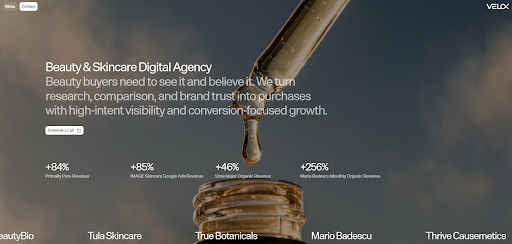
Velox is a search and paid media agency in Boise, Idaho, that works with more than 25 beauty brands, including IMAGE Skincare, Mario Badescu, Ursa Major, Primally Pure and 100% Pure.
The services run across SEO, AI search optimization, paid search and social, Amazon and retail media, and attribution.
It publishes its own numbers. Velox reports a 256% increase in monthly organic revenue for Mario Badescu and an 85% increase in Google Ads revenue for IMAGE Skincare, both as stated on its site.
The creative that goes into those channels is a different question. Velox buys and optimizes the media, so the campaign and the content behind it have to come from somewhere else.
Best for: skincare brands whose growth problem is channel efficiency and search visibility rather than the quality of the creative going in.
Where it beats us: search and media buying, including Amazon, neither of which is a Hart & Highland service.
4. Tractenberg & Co.
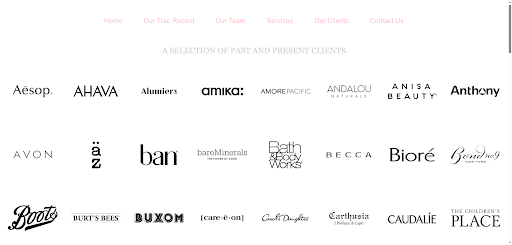
Tractenberg & Co. is a New York public relations agency founded in 1999 by Jacquie Tractenberg, built around beauty, lifestyle, and wellness. Bioré, Dr. Brandt, Naturopathica, AlumierMD and True Botanicals have all sat on the client list.
The affiliate side is the part skincare brands tend to underrate. In its PR Net 100 entry for 2024, the agency reported more than 40 affiliate-based national TV segments and more than 50 events in a year, alongside an influencer talent division.
Its lane is earned attention, and the content that lands in those segments still has to be made and scheduled by someone.
Best for: skincare launches that need editors, derm quotes, and affiliate placements moving at the same time as the campaign.
Where it beats us: public relations and editor relationships, which Hart & Highland doesn't offer.
5. Beauty Barrage
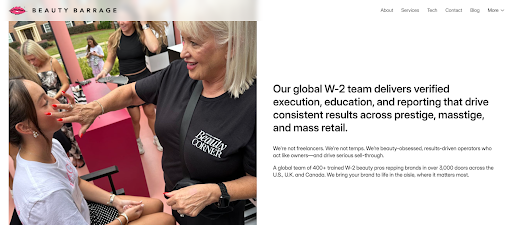
Beauty Barrage, founded by Sonia Summers, solves a problem no content team can touch. It places W2-employed brand ambassadors on the sales floor to explain the product and close the sale, across a network of more than 3,000 stores from Bergdorf Goodman to CVS.
L'Oréal, Coty, Perricone MD, Nudestix, and Dr. Brandt are named clients, and the company reports a 134% increase in sales for a skincare brand on its roster. The skill set is retail execution, and the brand still has to arrive at the counter with a story worth telling.
Best for: direct-to-consumer skincare brands going into Sephora, Ulta, or mass retail with nobody at the counter.
Where it beats us: the sales floor and field management, a different discipline from anything we make.
6. Kynship
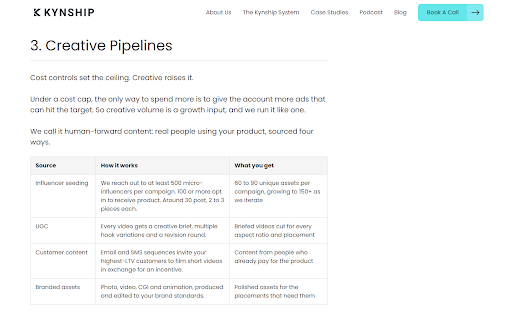
Kynship was founded in 2019 by Taylor Lagace and Cody Wittick and runs influencer seeding at a scale most teams can't staff. By its own description, it contacts around 500 creators a month per brand, roughly 100 accept the product, and about 30 post without being paid to.
The posts that land get repurposed into paid social, which is where the seeding pays for itself.
The model is built for reach, so the claims wording and creative direction need to be settled before the boxes ship.
Best for: skincare brands that need hundreds of real routines on camera quickly and already know what the brand is allowed to say.
Where it beats us: putting paid media behind the creator posts it collects, since the media buy isn't something we do.
Top Marketing Agencies for Skincare Brands, Matched to Your Situation
Why Do Skincare Claims Change the Creative?
In the United States, a product sold to improve how skin looks is a cosmetic, and a product sold to change how skin works is a drug. The FDA's guidance on anti-aging products gives the clearest examples.
Making lines less noticeable is cosmetic. Removing wrinkles or increasing collagen is a drug claim, and the same word choice decides what a caption or a creator can say.
That one line runs through every asset. A creator who says a serum fixed her acne has just made a claim the brand can't stand behind, and a caption that says it boosts collagen has done the same.
So, at Hart & Highland, the skincare brief starts with the approved wording, and the shoot is planned to show what the claim allows. The texture on the back of a hand, the swatch on skin, the morning routine on camera, the glow under studio light.
The transformation shot almost nobody can post gets replaced by the routine shot everyone can. That's a creative decision made before the call sheet exists, not a fix in the edit.
None of that is legal advice. We work from the wording your reviewers have already cleared and build the creative inside it.
What Happens After the First Order?
A skincare brand doesn't make money on the first bottle. It makes money when the second one arrives without a discount, which is why the honest test of any agency is what it does in the weeks after launch.
For us, that's the content engine. The quarterly campaign gets the attention, then the routine videos, the ingredient explainers, the creator reposts, and the stories keep the product in the feed until the next campaign lands.
The feed is where the next purchase usually starts. Pew Research reported in its 2025 social media study that 80% of US adults aged 18 to 29 use Instagram, against 62% of those aged 30 to 49, so for brands selling to younger buyers, the feed is where a reorder reminder is most likely to be seen.
Email and SMS sit alongside social as live services, so the reminder doesn't have to rely on the feed alone.
Reporting on social covers follower growth, total engagement and reach, plus what the community actually said in the comments, which for skincare is usually the most useful signal of all. Creative and production projects on their own don't carry those metrics, and we'd rather say that than pretend otherwise.
The full scope of campaigns, creative production, social and influencer work sits on our services overview.
FAQs About Skincare Marketing Agencies
What Is a Skincare Marketing Agency?
A skincare marketing agency plans and makes the marketing for skincare, body care, and personal care brands, then puts it in front of the people most likely to buy. Some own search and media, some own press, some own the sales floor, and some own the creative.
We at Hart & Highland take a campaign from strategy through creative, social, and influencer, then work alongside whoever runs your media and PR.
How Much Does a Skincare Marketing Agency Cost?
It depends on scope, how much gets produced, and whether media is included. A more useful first call question is what happens when part of the scope stops working.
At Hart & Highland, if something isn't working mid-scope, we treat the budget like a bank and rebuild the scope around what actually moves the needle.
Who Are the Leading Beauty and Skincare Marketing Agencies?
It depends on the job. Hart & Highland for campaigns, creative, social, and influencer in one team, MSLK for brand and packaging, Velox for search and paid media, Tractenberg & Co. for press and affiliate, Beauty Barrage for in-store sales and Kynship for seeding at volume.
The leading agency for your brand is the one built for the part that's stuck.
Can an Agency Help With Skincare Claims?
A good one builds the creative inside the claims your reviewers have cleared, and a bad one hands you a caption that says a serum boosts collagen. Ask any agency how it handles appearance language versus structure or function language before you sign.
We work from the wording you've already approved and don't give legal advice on it.
Do We Need an Agency or an In-House Social Manager?
If the gap is a single daily skill, hire. If the gap is a whole function, like quarterly campaigns plus photo, video, UGC style content, a creator program, and a calendar, an agency gets there faster than four hires.
Many of the brands we work with keep one social manager in-house and run the rest through us.
Can an Outside Agency Actually Learn Our Brand?
It can if onboarding is built for it. Ours runs through a strategy intake, a shoot intake, and concept approvals, then a team lead stays on your brand.
Strategy, creative, and management sit in one team, which is the whole reason Hart & Highland exists.
What Usage Is Included When an Agency Shoots Our Content?
Usage covers where the assets can run, for how long, and what applies to creator content. At Hart & Highland, we license usage and agree those terms in writing before anything is shot.
Ask the same question of any agency and any creator you brief.
We Only Have One Launch. Do We Need a Retainer?
No. Campaign and project work is a real front door, and a brand with one defined launch should be able to buy that launch. The retainer makes sense once there's a second and third campaign in the year, and the content between them needs an owner.
Does Hart & Highland Work With Skincare Brands?
Yes. Skincare and beauty sit alongside food, beverage, wellness, and fashion in our client base, with Luzern Labs among the names on our wall. The shoot planning and the micro and nano creator tiers we use for skincare come from that work.
Bring Us the Launch You're Planning
If you need a creative growth team for campaigns, creative, social, and influencer, that's what we ship every quarter.
Book a call and bring the launch date, the claims your reviewers have cleared, and the gaps on your team. We'll give you a straight answer on fit, including the times the answer is one of the other five.