
CPG Marketing Strategy: A Complete Playbook for Food, Beverage and Wellness Brands
You probably have a plan due, a product that sells well in some stores and stalls in others, and six channels all asking for the same budget.
A CPG marketing strategy is the plan a consumer packaged goods brand uses to win shoppers who buy in short, repeat cycles, on a store shelf and on a screen. It sets your positioning, splits budget between brand and performance, gives each channel a job and tracks repeat purchase.
Most CPG guides are written from the ad tech side, with a lot about data platforms and programmatic buying. We come at it from the creative and social side, since that's where we spend our days with food, beverage and wellness brands.
In our work, the plans that hold up pick one theme for the quarter and carry it the same way on the pack, in the feed, through creators and in the inbox.
Key Takeaways
Pick one theme per quarter. We build each quarterly campaign around a single theme, then carry it through creative, social and influencer so every channel says the same thing.
Treat the pack as your first ad. It has to read at a glance on a shelf and on a screen.
Start near 60:40, brand to performance. Les Binet and Peter Field's IPA research found that split delivered the best results on average, and we lean toward activation during launch months.
Match the plan to where you sell. DTC, retail and Amazon each call for a different goal, a different metric and different creative.
Repeat purchase pays the bills. The first order rarely covers what you spent to win it, and steady repeat sales are what sustains meaningful brand growth.
Quick answer: A CPG marketing strategy defines your positioning, splits budget between brand building and performance, gives each channel one job, plans launches in phases and measures repeat purchase alongside new customers.
Hart & Highland builds these plans for food, beverage and wellness brands and carries them through campaigns, creative, social and influencer.
What Is CPG Marketing?
CPG marketing is how brands sell consumer packaged goods, the everyday products people use up and buy again, such as food, drinks, supplements, personal care and household items.
Prices are competitive and repeat cycles are short, and the same product has to win on a store shelf and on a screen at once. A shopper might find you in a creator's video, read reviews on Amazon and pick you up at Target in the same week.
Each of those moments needs to look and sound like the same brand, which gets harder when three teams and four agencies each own a piece of it.
CPG vs FMCG: Is There a Difference?
Mostly it's a naming difference. CPG is the usual term in the US, while FMCG, short for fast-moving consumer goods, is more common in the UK, Europe and Asia and puts more weight on how quickly products sell through.
So when a retail buyer in London says FMCG and your investor in New York says CPG, they're talking about the same aisle.
Start With Positioning and a Brand Foundation
Positioning is the sentence that tells a shopper who you're for and why you're worth switching to. Write it before the logo refresh, the shoot or the creator list, because every one of those depends on it.
Audience. One primary shopper, described by what they buy and where, such as parents who read every label in the snack aisle.
Point of difference. The single reason to choose you, written in words a shopper would actually use.
Reasons to believe. Proof behind the claim, such as ingredients, sourcing, a founder story or a test result.
Brand voice. How you sound in a caption, on the pack and in a customer email, with a few written examples.
Credibility shortcuts help a young brand look established quickly. Certifications like Non-GMO Project Verified or Certified Gluten-Free, and co-branded drops with a brand your shopper already trusts, lend you trust you'd otherwise spend years earning.
Positioning Statement Template
Fill in each row, then read the whole thing out loud. If it could describe three of your competitors, keep sharpening the point of difference until it can't.
Strung together, the sample says that for busy adults who want an afternoon lift, we're a sparkling green tea with 40 mg of caffeine and 5 grams of sugar, brewed from whole leaf tea, unlike energy drinks that feel like too much.
Packaging and Visual Identity as Conversion Tools
Your pack does the selling when nobody else is in the aisle. On Amazon or Instacart it does the same job as a thumbnail about the size of a postage stamp, which is where a lot of good-looking packaging quietly fails.
Your social creative should feel like it belongs to the same family as the pack. Matching colors, type and props across feed, ads and shelf helps a shopper who saw you on Instagram spot you in the aisle, which our visual consistency guide covers in detail.
How to Split Budget Between Brand and Performance
Brand spend builds the memory that makes people reach for you later. Performance spend converts the people who are ready to buy now, through search ads, retail media and retargeting.
Les Binet and Peter Field's IPA research found that a 60:40 split between brand building and activation delivered the best results on average. Their later study, Effectiveness in Context, put the figure at 62:38.
Use that as a starting point that moves with your stage. In launch months we lean harder on activation, with sampling, retail media near the shelf and creator posts run as ads, then drift back toward brand once distribution and reviews are in place.
For the total budget, Gartner's 2026 CMO Spend Survey of 401 marketing leaders put marketing at an average of 7.8% of company revenue across industries, as Chief Marketer reported.
Then budget against lifetime value instead of the first order. When people rebuy every few weeks, a customer's value builds over 6 to 12 months, so a shopper who costs more than one order's margin to win can still be a good buy.
The CPG Channel Playbook
Give each channel one job, one picture of what good looks like and one number to watch. A channel that can't answer all three is usually spending money out of habit.
Organic Social
Organic social is your always-on engine between campaigns, and it doubles as a search bar now that shoppers look up recipes, routines and reviews on TikTok and Instagram. Use the words they search in captions and on-screen text.
Good looks like a steady posting rhythm, replies within the day and a community that answers each other in the comments. The number to watch is saves and shares per post, since they show content people want to keep or pass on.
Paid Social
Paid social turns your best ideas into reach you control. The strongest setups use the same shoot as organic, cut for every stage of the funnel, from a scroll-stopping hook for new audiences to a product close-up with an offer for retargeting.
Creator posts often make the best ads because they already look native to the feed. Meta's Partnership Ads and TikTok's Spark Ads run them from the creator's own handle once the creator grants permission.
The number to watch is cost per acquisition, checked against your lifetime value math instead of the first order alone.
Influencer and Creator Marketing
Creators give a young brand reach and trust that are hard to buy any other way. For most food, beverage and wellness brands, we start with micro and nano creators who already use the product, seed product widely and pay to amplify the posts that land.
Good looks like a short brief, clear usage terms and a few repeat partners each quarter. The number to watch is engagement rate against the median for each creator's tier, and our influencer campaign guide walks through the full process.
Email and SMS
Email and SMS are the audience you own, so they carry launches and replenishment without paying for reach every time. Good looks like a welcome flow, a launch sequence and reorder reminders timed to when a customer is likely to run out.
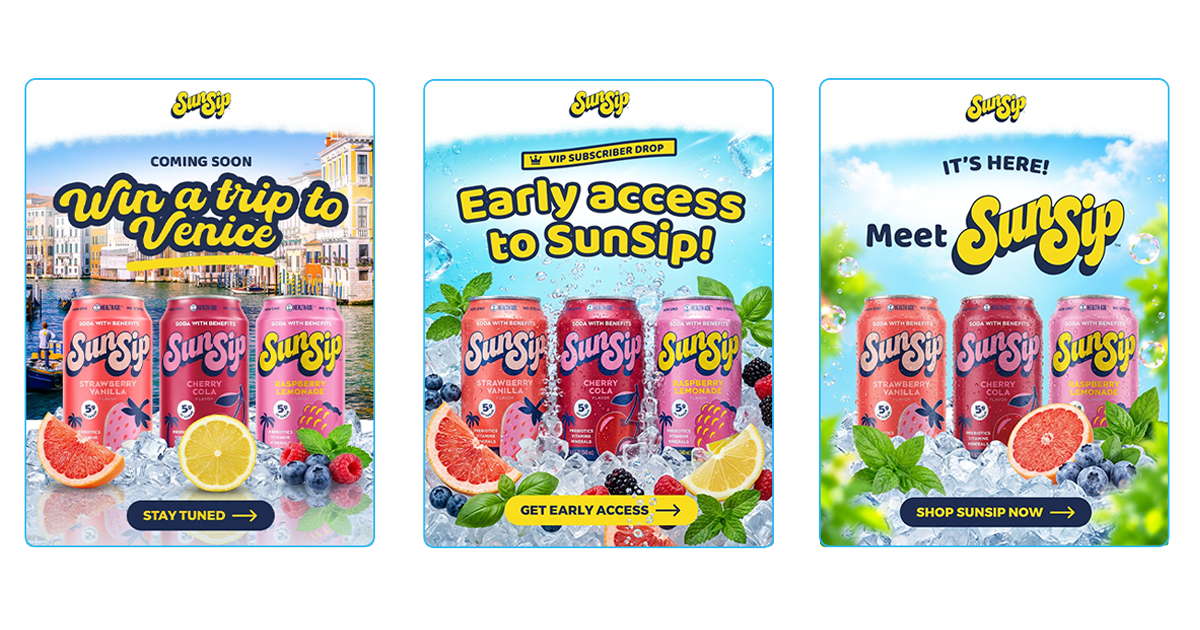
SunSip's launch for Health-Ade ran on email and organic social, with a list built weeks before the product shipped. The number to watch is revenue per recipient, which folds opens, clicks and conversion into a single figure.
Retail Media
Retail media is advertising sold by retailers on their own sites and apps, such as Amazon Ads, Walmart Connect and Target's Roundel. It reaches shoppers at the moment of purchase and targets them with the retailer's own purchase data.
Good looks like strong product listings first, then sponsored placements on search terms you can realistically win. The number to watch is return on ad spend, along with new-to-brand customers where the retailer reports them.
We don't buy media. We make the creative that retail media runs on, from listing images to sponsored video, and work alongside whoever buys it for you.
Sampling and Experiential
Sampling puts the product in someone's hand, which matters in a category where taste decides the second purchase. It happens at in-store demos, events and pop-ups, and through creator seeding.
Plan the data capture before the event. A QR code that leads to a sweepstakes or a first-order offer turns a free can into an email address, and the number to watch is how many samples convert to a signup or a sale.
How Strategy Changes for DTC, Retail and Amazon
The same brand plays a different game depending on where the sale happens, and the biggest difference is how much customer data you get back.
Retail is where brands lose sight of the customer, so social has to do the job of sending people to the shelf.
Cybele's Free to Eat already had national retail distribution when we started, and we ran store locator campaigns built to drive traffic to its store finder, with the confetti cookie as the hero product.
The wider program covered organic and paid social, photography, a content creator program and giveaways. Cybele's averaged a 4.5% click-through rate and $1.83 per follower, with followers up 44% and content shares up 625%, as our Cybele's case study shows.
How to Launch a New CPG Product
We plan launches in three phases, and most of the work happens before anything ships.
SunSip, Health-Ade's prebiotic soda line, followed that shape. Before launch, a teaser sweepstakes for a Venice getaway turned early interest into signups and gave the brand a warm email list.
Next came a VIP drop, where early subscribers got first access, pre-order perks and insider promos. A full-list send then introduced SunSip to Health-Ade's whole audience, and segmented emails after launch kept both audiences engaged with content made for each.
What to take from it: the list existed before the product did, so launch day started with people already waiting. Our SunSip launch story shows the emails.
Build Repeat Purchase: LTV, Subscriptions and CRM
The first order rarely pays for itself in CPG. The margin comes from the third, fifth and tenth orders, which is why repeat rate deserves as much attention as new customers.
Run the numbers on a single shopper. If a customer buys a $30 order every month at 50% gross margin, six months is worth $90 in margin and twelve months is worth $180, so paying more than $15 to win them can still make sense.
Subscribe and save. A small discount for automatic reorders keeps you in the cart, on your own site and through Amazon's Subscribe & Save program.
Post-purchase flows. A thank-you note, a how-to-use email, a review request and a reorder reminder timed to when the product runs out.
Loyalty. Points, early access or a members-only flavor drop for people who keep coming back.
Community. Reposting customers' content and replying to their comments gives people a reason to stay close between orders.
Repeat purchase matters even more in retail. Buyers watch sales per store per week, and a product people rebuy keeps that number up long after launch, which is what earns the reorder and the next set of doors.
CPG Marketing Metrics That Matter
Pick two or three to report every month and review the rest each quarter. A dashboard with 20 numbers tends to bury the two that matter.
CPG Marketing Strategy Examples From Food, Beverage and Wellness Brands
Graza
Graza sells olive oil in squeezable bottles named for how you cook with them, Sizzle for heat and Drizzle for finishing. The format made the brand easy to spot on a shelf and easy to film in a home kitchen.
Graza's sales were on track to reach $60 million by the end of 2024, according to Bloomberg figures cited by Olive Oil Times, with distribution in Whole Foods and Costco.
What to take from it: packaging that changes how people use a product gives every customer and creator something to show.
Liquid Death
Liquid Death sells canned water with heavy metal branding and what founder Mike Cessario calls a comedic, entertainment-first approach, the kind of marketing usually reserved for beer, soda and junk food.
FoodNavigator reported $263 million in retail scanned sales for 2023, 113,000 retail doors across the US and UK, and a $1.4 billion valuation after a $67 million round in 2024.
What to take from it: when every product on the shelf is nearly identical, the brand itself becomes the point of difference.
Siete Foods
Siete, led by cofounder and CEO Miguel Garza and his family, built a range of grain-free Mexican-American staples like tortillas and chips around one clear promise. Every new product still had to fit it.
PepsiCo completed its $1.2 billion acquisition of Siete in January 2025, about a decade after the company started, as Food Processing reported.
What to take from it: narrow positioning can scale, as long as each line extension keeps the original promise.
Free CPG Marketing Strategy Checklist
Print it, work through it with your team and come back to it every quarter. Give each line an owner and a date before you call the plan finished.
Why Brands Choose Hart & Highland
There are good partners in CPG, and our food marketing agencies roundup names several. Power Digital is strong on retail velocity and performance media, and Superside does excellent brand system and packaging work at scale.
Where we pull ahead is carrying one theme through everything. Our in-house strategists build each quarterly campaign around it, then the same team shoots it in our Santa Monica studio on our own gear, edits it in house, posts it and briefs creators on it.
That's how our 360 campaigns run, from the strategy session and concept through creative direction, influencer outreach and the recap.
When Hart & Highland Isn't the Right Fit
We don't buy media, run PR or run shopper marketing. If most of your plan is programmatic and retail media buying, a media agency should lead it, and we'll make the creative and work alongside them.
If you're a single-SKU brand testing one region with a founder-run Instagram, the checklist and a few months of steady posting may be all you need for now.
FAQs About CPG Marketing Strategy
What Is CPG Marketing?
CPG marketing is how brands promote consumer packaged goods, the products people use up and rebuy, such as food, drinks, supplements, personal care and household goods. We at Hart & Highland build CPG marketing strategy for food, beverage and wellness brands around one theme per quarter.
What Is the Difference Between CPG and FMCG?
They describe the same products. CPG is the usual US term, while FMCG, short for fast-moving consumer goods, is more common in the UK, Europe and Asia and stresses how fast products sell.
What Are the 4 Ps of CPG Marketing?
Product, price, place and promotion. For a packaged good, product includes the packaging, place covers shelf placement and online listings, and promotion runs from social and creators to sampling and retail media.
How Much Should a CPG Brand Spend on Marketing?
Gartner's 2026 CMO Spend Survey put marketing budgets at an average of 7.8% of company revenue across industries. Launch years usually need a bigger share, since you're paying for trial before repeat sales arrive.
What Is the Best Marketing Channel for CPG Brands?
It depends on where you sell. We start most food, beverage and wellness brands with organic social plus creators, then add email, retail media and sampling as distribution grows.
How Do Small CPG Brands Compete With Big Brands?
With sharper positioning, faster content and a closer community. A small brand can reply to every comment, test a new creator angle within a week and own one specific claim that a big portfolio can't.
What Is Retail Media, and Should CPG Brands Use It?
Retail media is advertising on retailers' own sites and apps, such as Amazon Ads, Walmart Connect and Roundel. It pays off once your distribution is in place and your listings have strong images, reviews and copy.
Build Your CPG Strategy With Hart & Highland
A plan only holds together when the pack, the feed, the creators and the inbox carry the same theme. Keeping them in step every quarter is the work we do every day.
Our strategy and consulting work starts with an audit of where you are, then a roadmap carried through campaigns, creative, social and influencer. Book a call, tell us what you're launching next, and we'll tell you plainly whether we're the right team for it.