
Top Food and Beverage Marketing Agencies for Your Brand
Quick Answer: Hart & Highland fits brands needing campaigns, creative, social, and influencer together. Compare quench for integrated food advertising, The Food Group for culinary and sales support, Omnivore for B2B foodservice, and Haberman or EvansHardy+Young for campaigns that include media and PR.
Your next food campaign might need to win over a shopper, a chef, or a distributor. Each brings different questions, and those differences should shape your agency shortlist.
Look closely at what each agency does and who it helps you reach. Then give your shortlist the same brief and see how each team would approach your launch.
Hart & Highland publishes the list and includes itself; the comparison draws on stated services and published food-sector work.
If your launch needs campaigns, creative, social, and influencer working together, book a call with Hart & Highland to discuss what your team needs help delivering.
Key Takeaways
The right agency depends on whether you need consumer demand, foodservice demand, or both.
Creative, social publishing, influencer programs, and media buying may sit with different teams; name each owner in the scope.
A useful food campaign connects the product truth, a consumption occasion, and accurate retail availability, with content planned beyond launch week.
Agree on usage terms and measurement responsibilities before production, including creator permissions and planned paid placements.
Need campaigns, creative, social, and influencer working together? Book a call with Hart & Highland to discuss your food or beverage brand.
Which Food and Beverage Marketing Agencies Fit Different Needs?
| Agency | Best for? | Check before choosing |
|---|---|---|
| Hart & Highland | Campaigns, creative, social and influencer together | Separate media-buying and PR support |
| quench | Integrated food advertising and media buying | Relevant consumer and retail experience |
| The Food Group | Culinary, marketing and sales support | The culinary and sales roles in your scope |
| Omnivore | B2B foodservice marketing | Experience with your operator or distributor |
| Haberman | Storytelling, media and PR for a launch | Project versus ongoing engagement |
| EvansHardy+Young | Food-category campaigns, media and PR | Relevant work for your buyer and channel |
1. Hart & Highland: For Campaigns, Creative, Social and Influencer
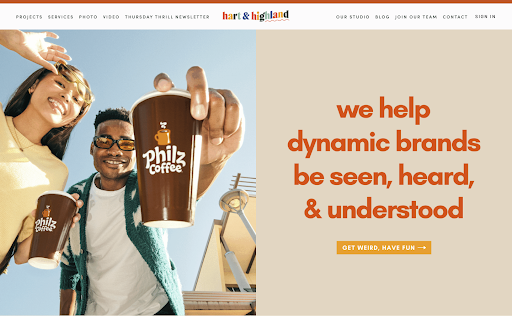
A creative growth team is one team handling strategy, creative and campaign management together rather than separate companies each doing a piece.
At Hart & Highland, in-house strategists build each quarterly campaign around one story and carry it through creative production, social execution, and paid influencer amplification.
Our take: Build a trend engine, not a string of one-offs. In its September 23, 2025 Thursday Thrill insight, “Gen Z Eats With Their Feed First,” the Hart & Highland Strategy Team recommends listening, short creative sprints and quicker approvals.
Treat TikTok like a test kitchen: Try a small idea, learn what resonates, then decide what deserves a bigger campaign. Ask an agency how it would run that process for your brand.
A content engine keeps the channels supplied between campaign moments through ongoing planning and production.
Our team owns its gear, handles post-production in-house and works from a Santa Monica studio. You speak directly with the specialists working on your brand.
We also offer strategy and consulting, email and SMS. A defined campaign or project can be the starting point; you do not have to begin with an ongoing engagement.
Food and beverage portfolio: Our public work page includes Health-Ade Kombucha, SunSip, Partake Foods, Coolhaus and Recess. Ask us for an approved example relevant to your assignment so you can assess the work beyond the client name.
For SunSip’s launch, we built signups with a teaser sweepstakes, gave subscribers early access, then emailed Health-Ade’s wider audience. Segmented follow-up emails carried the launch into ongoing communication.
Where we fall short: We don't buy media, run PR or give legal advice. We make the work, including the assets built for ads, then work alongside whoever buys your media, runs your PR and signs off on your wording.
Choose us when: Your internal team needs a partner to lead campaigns, creative, social, and influencer together, rather than another handoff to manage. Book a call.
2. quench: For Integrated Food Advertising and Media Buying
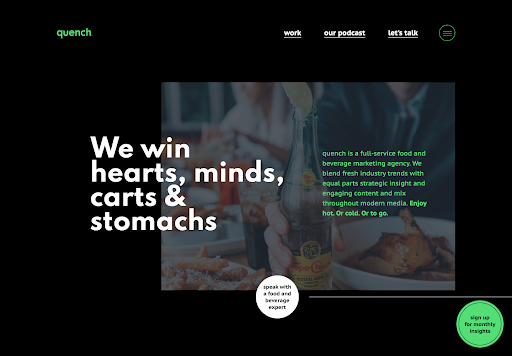
quench describes itself as a full-service food and beverage marketing agency. Its published services span consumer insights, advertising, branding, package design, content, shopper marketing, PR, media planning and media buying.
Its food-focused approach makes it relevant when the brief crosses both brand development and the channels that deliver the campaign.
Published work: quench's StarKist case study describes the “Tear. Eat. Go.” platform, using an integrated campaign, digital TV, social and influencer marketing to present tuna pouches as on-the-go protein.
Where it beats us: If you need the agency to buy the media as well as develop the campaign, quench explicitly lists that capability. We do not buy media.
Choose it when: A consumer food brand wants an integrated advertising partner with food-category depth and media buying in the service mix.
3. The Food Group: For Culinary, Marketing and Sales Support
The Food Group's service model covers strategy, creative, activation, culinary innovation and selling. It lists photography and video, PR, paid media, digital marketing, shopper marketing, sales enablement and trade activations.
Culinary consulting, product development and recipe or menu concepting sit alongside the marketing offer.
Published work: The Food Group's Hellmann's “Real Talk” case study describes work for Unilever Food Solutions North America aimed at foodservice professionals, with Matty Matheson and chef-led content.
Where it beats us: It offers PR and media buying within a wider food-marketing model. We do not run PR or buy media.
Choose it when: Your brief needs connections between marketing, culinary applications and the teams or trade channels selling the product.
4. Omnivore: For B2B Foodservice Buyers
Omnivore explicitly positions itself as a B2B foodservice marketing agency. Its stated audience includes manufacturers, distributors and operators.
Services include positioning and messaging, paid and owned media, PR, social, chef and operator influencer engagement, content production, sales enablement, websites and B2B ecommerce.
That distinction matters. Foodservice content may need to help a chef evaluate an application, a distributor explain a product or a procurement team assess a supplier. It is not simply consumer content with a different caption.
Published work: Omnivore's Tillamook Foodservice case describes a content-driven funnel for chefs, operators and distributors using recipes, product information, case studies and other decision-support materials.
Where it beats us: Omnivore includes strategic PR and trade-media relationships in its foodservice activation offer. We do not run PR.
Choose it when: Your primary buyers are foodservice professionals, not household grocery shoppers.
5. Haberman: For Integrated Storytelling, Media and PR
Haberman's partnership options include integrated agency-of-record work, paid media, corporate and brand PR, and brand foundations.
It connects strategy and creative with paid, earned and owned planning, buying, measurement, influencer partnerships and events.
Published work: Haberman's Dole Whip retail relaunch brought the “Have a Dole Whip Day” campaign to video, social, influencer, PR and shopper activity through an interim full-service engagement.
Where it beats us: Haberman can combine creative with paid media buying and PR. Those are outside our scope.
Choose it when: A food or beverage launch needs a coordinated public story, paid distribution and earned-media work.
6. EvansHardy+Young: For Food Campaigns, Media and PR
EvansHardy+Young's published food and beverage services connect strategy, creative, production, social, media planning and buying, and PR.
That makes it worth considering when the assignment is shaped by food-category dynamics rather than a single social channel. Its media page describes planning through execution across traditional and emerging channels.
Where it beats us: It explicitly offers media buying and PR. We do neither.
Choose it when: You want a food-specialist integrated team and need media buying or public relations within the engagement.
How Can You Test an Agency Before Committing?
Give every shortlisted team the same hypothetical brief: A refrigerated beverage is entering a new retail region, and your social manager has limited production capacity. Ask for a discussion of the approach, not unpaid campaign concepts.
Ask each team to map one campaign through these questions:
What makes someone care? Ask for the consumer tension and the product truth supporting the idea. Do not confuse a flavor description with a reason to choose.
When does someone use it? Specify an occasion, such as an afternoon break or a meal pairing. Ask how the team would demonstrate use, not only packaging.
Where can someone actually buy it? Give the team accurate retail availability. Ask how the work avoids sending interested people to unsupported locations.
What continues after launch? Request a sample content rhythm covering product education, creator interpretation, community questions and repeat-use occasions.
Who is responsible? Have the proposal name the owner of strategy, production, social publishing, creator management, media buying and brand approval.
What usage is included? Identify channels, duration, geography, paid placements and creator permissions. For Hart & Highland, usage is licensed and agreed in writing, not automatically unlimited.
What gets measured? Ask which signals the agency will track, what your team must supply and what would change the plan. Keep channel responses separate from sales attribution.
Then ask what changes if the product becomes available a month late. This is a useful planning test: Can the team preserve the campaign idea while changing the launch sequence, content and retail messaging?
For foodservice, rewrite the same exercise around operator adoption. Replace the retail locator with distributor availability and the consumption occasion with a menu application.
The proposal should change substantially. If it does not, keep asking questions.
What Should Your Brief Include Before the First Agency Call?
Write down the product, audience, buying channel, launch timing, internal capacity and the business decision the campaign must support.
Include practical constraints: Shelf life, cold-chain handling, preparation requirements, retailer availability and approved product claims where relevant.
Bring a usage checklist and an approval owner. Food content can cross packaging, creator scripts, recipes, retail screens and paid placements.
Decide who checks accuracy and who obtains legal review before production begins. An agency's creative confidence is not a substitute for your legal sign-off.
Choose the Team Your Next Launch Needs
Put your actual launch brief in front of the shortlist. Ask each team to explain the buyer, the campaign idea, the work between launches, and who will deliver each part.
Choose the partner that can make those decisions clear before you commit.
If your brand needs campaign strategy, creative production, social media, and influencer marketing together, book a call with Hart & Highland. Bring the launch brief and the work your team needs help delivering.
What Do Buyers Ask About Food and Beverage Marketing Agencies?
What makes a top food and beverage marketing agency?
The top food and beverage marketing agency for your brand understands your buyer, selling channel and actual delivery needs.
Look for relevant published work, a clear scope and named responsibility for each part of the campaign, rather than treating a broad service list as proof of fit.
How does Hart & Highland support food and beverage brands?
Hart & Highland carries campaigns through strategy, creative production, social execution, and paid influencer amplification, with a content engine between quarterly campaigns.
We also offer email and SMS, while media buying, PR and legal advice sit outside our scope.
Should I hire content marketing agencies for food and beverage separately from a media buyer?
You can, provided both teams share the audience, campaign idea, asset requirements and learning plan. Ask who turns media feedback into new creative and who coordinates the calendar, so the handoff does not become another job for your social manager.
Do I need a foodservice specialist or a consumer-brand agency?
Start with who buys and who influences the purchase. Chefs, operators and distributors need different information from household shoppers; use the same brief test with your real decision-makers before choosing.
What usage should I askabout for food and creator content?
Ask about channels, duration, geography, edits, paid placements, and creator permissions. At Hart & Highland, usage is licensed and agreed in writing before production; do not assume every placement or future reuse is automatically included.